The Short Answer
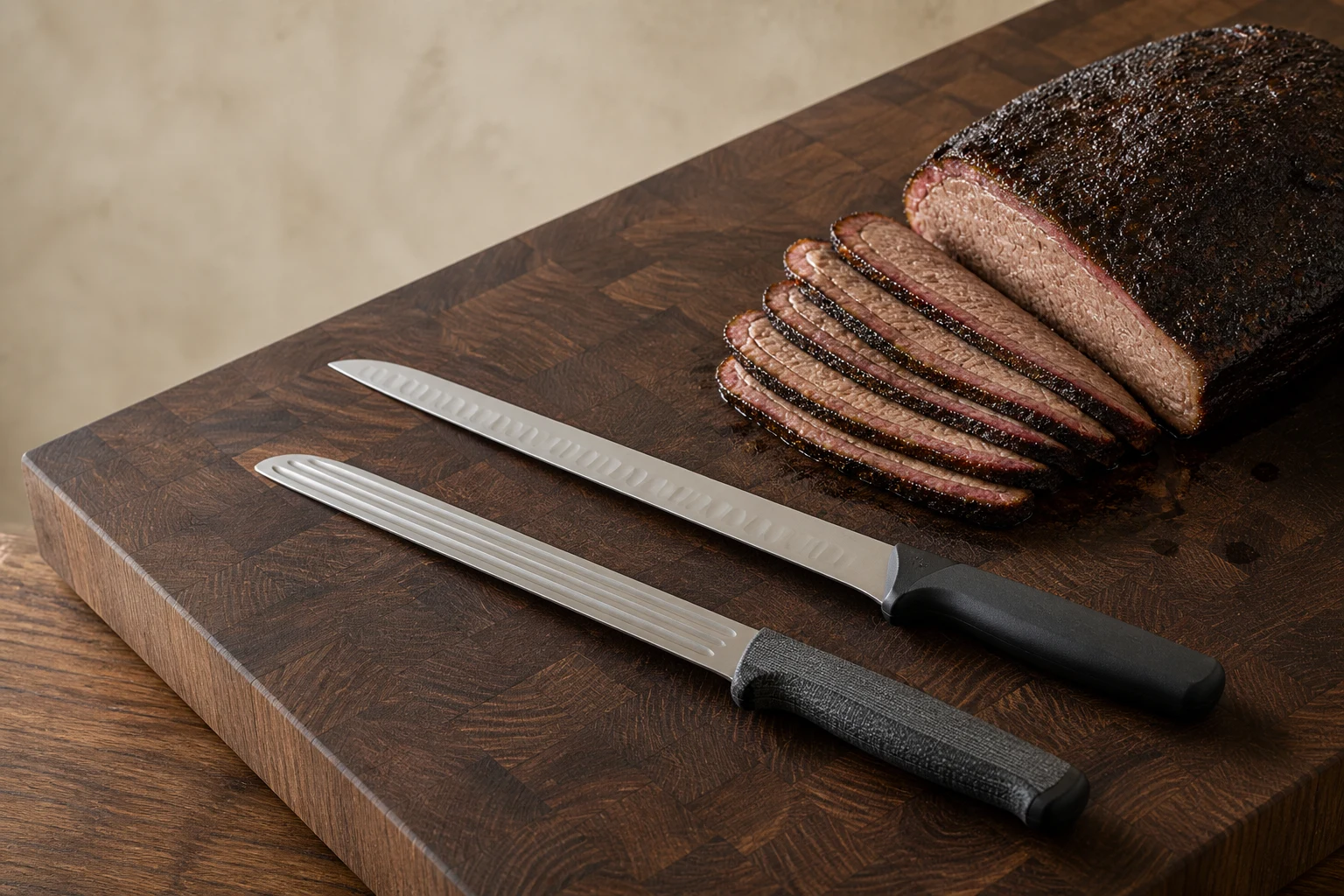
Choose the Mercer Culinary Millennia 14-Inch Granton Slicer when your priority is spanning a wide packer brisket in one long stroke at a relatively accessible commercial-tool position. Choose the Victorinox Fibrox 12-Inch Granton Slicing Knife when you want a shorter, lighter Swiss-made tool with a manufacturer lifetime warranty and easier storage.
The knife begins working only after the meat is cooked and rested correctly. Follow the smoked brisket guide first, then identify grain direction before cutting. For other large cuts, the beef roast guide and chuck roast guide explain why tenderness and grain differ from one muscle to another.
The Two Exact Slicers We Would Shortlist
| Pick | Blade format | Best fit | Main tradeoff |
|---|---|---|---|
| Mercer Millennia M13914 | 14-inch granton edge, high-carbon Japanese steel | Wide briskets and buyers prioritizing blade length per dollar | Needs a larger board, drawer or guard |
| Victorinox Fibrox 5.4723.30 | 11.8-inch fluted edge, Swiss made | Easier control and storage with premium manufacturer support | May need a second stroke across the widest flat |
What Actually Makes a Good Brisket Knife
Length reduces sawing. A blade that reaches across most of the brisket lets you draw from heel toward tip in one controlled motion. Repeated short strokes drag bark back and forth and can compress the soft flat. More length is useful only when the cook can control it without reaching beyond a stable board.
A narrow blade reduces drag. Broad chef's knives push more steel through each slice. A long slicer uses a narrower profile and often a granton or fluted treatment to reduce sticking. Those recesses help, but they do not make a dull edge sharp or prevent tearing when the user presses straight down.
Handle security beats visual polish. Brisket fat makes hands and handles slippery. A textured, cleanable grip and enough knuckle clearance matter more than wood grain or a display box. Wash and dry your hands, keep a towel nearby and stop if the handle becomes greasy.
| Feature | Useful question |
|---|---|
| Blade length | Can it span the brisket while staying within my cutting board? |
| Edge geometry | Can I maintain it with my current sharpening method? |
| Handle | Does it remain secure and comfortable through repeated drawing strokes? |
| Storage | Do I have a fitted guard, block or protected rack for a 12- to 14-inch blade? |
How to Slice Brisket Cleanly
- Rest the brisket, then place it on a large dry board with a juice channel or a rimmed tray beneath.
- Separate or reorient the point when necessary because the flat and point grain do not run in the same direction.
- Use long drawing strokes with minimal downward force; do not chop or rapidly saw.
- Slice the flat across the grain to the thickness appropriate for its tenderness, then adjust for the point.
- Move finished slices with a gloved hand or spatula rather than using the knife as a lever.
If the meat crumbles under a sharp knife, it may be overcooked or sliced too hot and thin. If each slice stretches and resists, it may be under-tender or cut with the grain. The tool cannot correct cooking or orientation errors, but a suitable blade makes correct technique easier to repeat.
For sandwiches, cut only what will be served and keep the remaining brisket intact to slow moisture loss. The steak sandwich guide uses different cuts, but its advice on cross-grain slicing and balanced slice thickness applies.
Maintenance and Safety
Hand washing is the conservative routine even when a manufacturer describes a knife as dishwasher safe. A dishwasher can expose the edge to impacts, strong chemicals and handling hazards. Wash with the edge facing away, dry immediately and store in a fitted guard or protected rack.
Honing and sharpening are different. Honing realigns a fatigued edge; sharpening removes metal to form a new apex. Follow the maker's edge guidance, use a stable sharpener appropriate to the blade and do not practice aggressive freehand sharpening on an unfamiliar long knife.
Never leave a slicer hidden in a sink or under butcher paper. Carry it point down at your side, announce movement in a shared kitchen and place it where the handle cannot be knocked off the counter.
If You Need Another Length or Handle
Verdict
The Mercer M13914 is our value specification match for full packer brisket because its 14-inch granton blade emphasizes long clean strokes and its commercial handle design prioritizes grip. The Victorinox Fibrox is the more compact premium alternative with an 11.8-inch fluted blade, Swiss manufacture and lifetime warranty.
Choose the longest blade you can safely control and store—not the longest number in a listing. A sharp 12-inch slicer on a stable board beats a 14-inch tool that collides with the counter edge or lives loose in a drawer.
Where This Guide Fits
This page supports the broader best meat thermometer for steak guide. Use that pillar page for the complete cut family, buying framework and links to every closely related article.
Useful next reads include best cast iron skillet for steak, best smoker thermometer, best butcher paper for brisket, Cast Iron Steak, and Smoked Brisket for nearby cuts, methods and decisions.
Frequently Asked Questions
What length knife is best for brisket?
A 12- to 14-inch slicer works for most full briskets. Choose a blade that spans the flat while remaining safe on your board and in your storage setup.
Is a granton edge necessary for brisket?
No. It can reduce sticking and drag, but edge sharpness, blade length and long drawing strokes matter more.
Is the Mercer or Victorinox better?
Mercer is our long-blade value match; Victorinox is the shorter premium alternative. The better fit depends on workspace, control, storage and budget.
Can I use a chef's knife for brisket?
Yes, but a shorter broad blade often requires more strokes and creates more drag. A long narrow slicer makes clean cross-grain portions easier.
Were these knives tested by Just Great Steaks?
Not yet. The comparison uses manufacturer construction, dimensions and warranty information without claiming a private sharpness or durability test.
Sources & further reading
- Mercer Culinary — Millennia 14-Inch Granton Edge Slicer — Manufacturer steel, handle, edge, safety and warranty specifications
- Victorinox — Fibrox 12-Inch Granton Slicing Knife — Manufacturer dimensions, materials, edge, origin and warranty
- Amazon — Mercer M13914 (ASIN B005P0OIBM) — Exact marketplace product identity
- Amazon — Victorinox Fibrox Slicer (ASIN B0000CFDB9) — Exact marketplace product identity