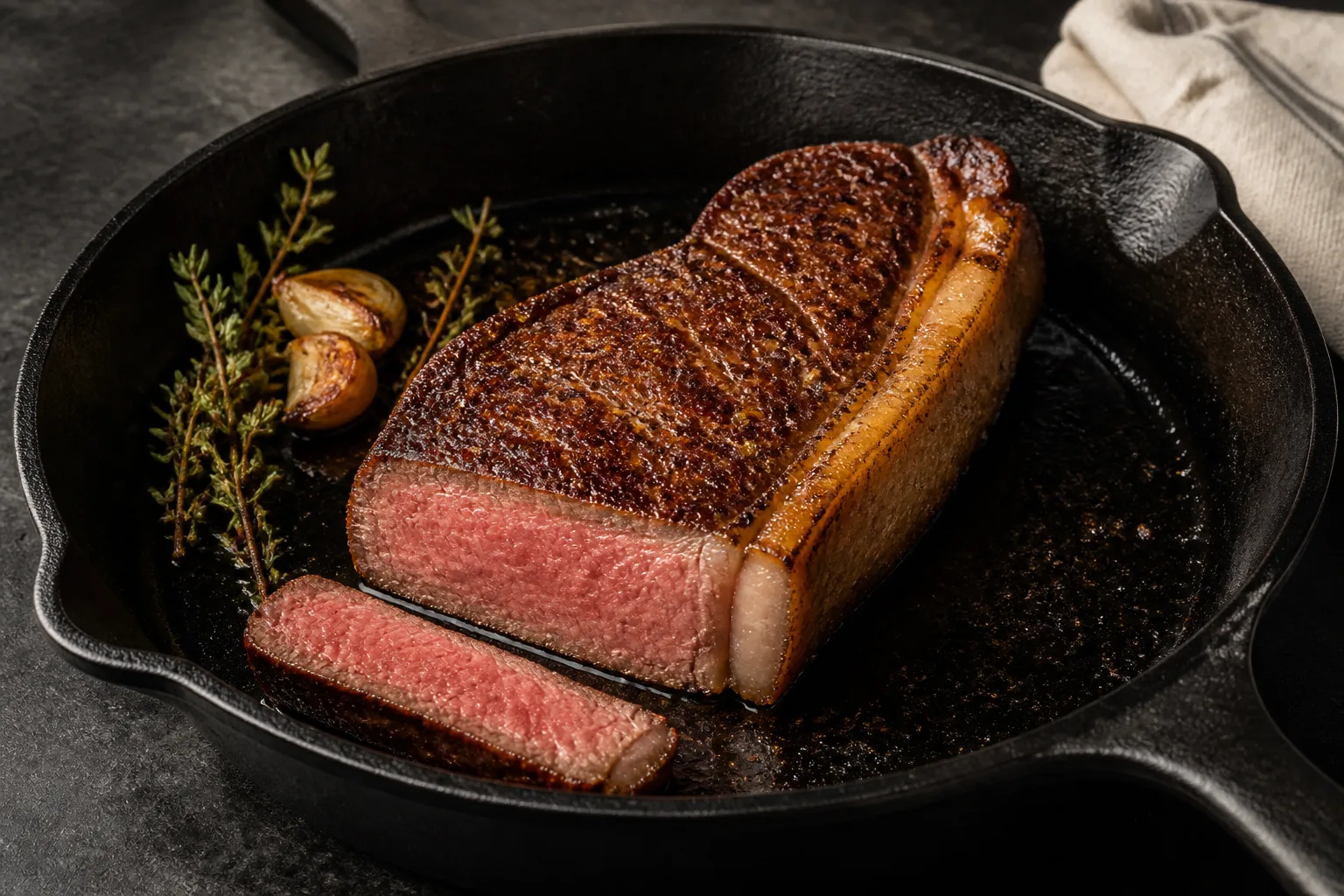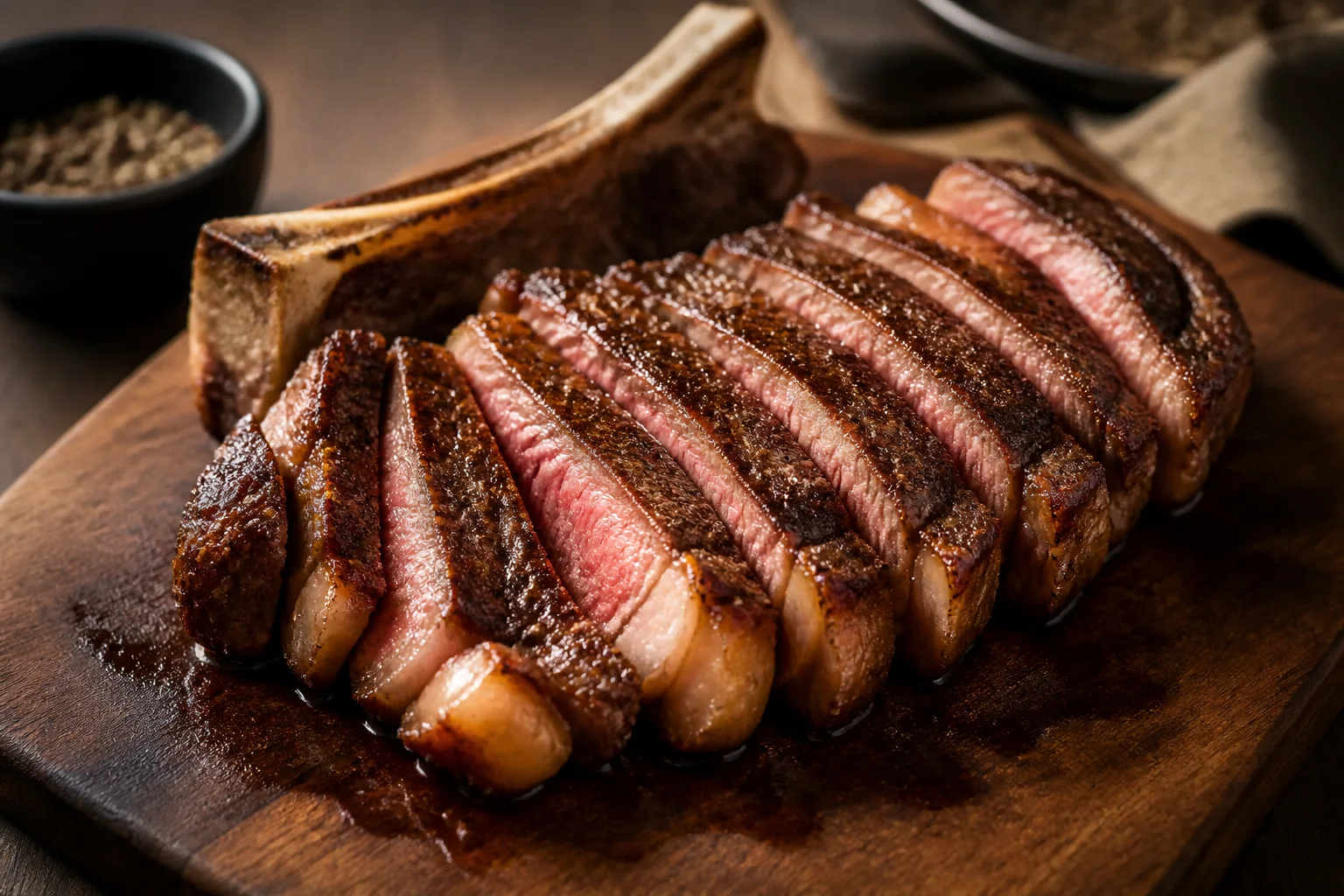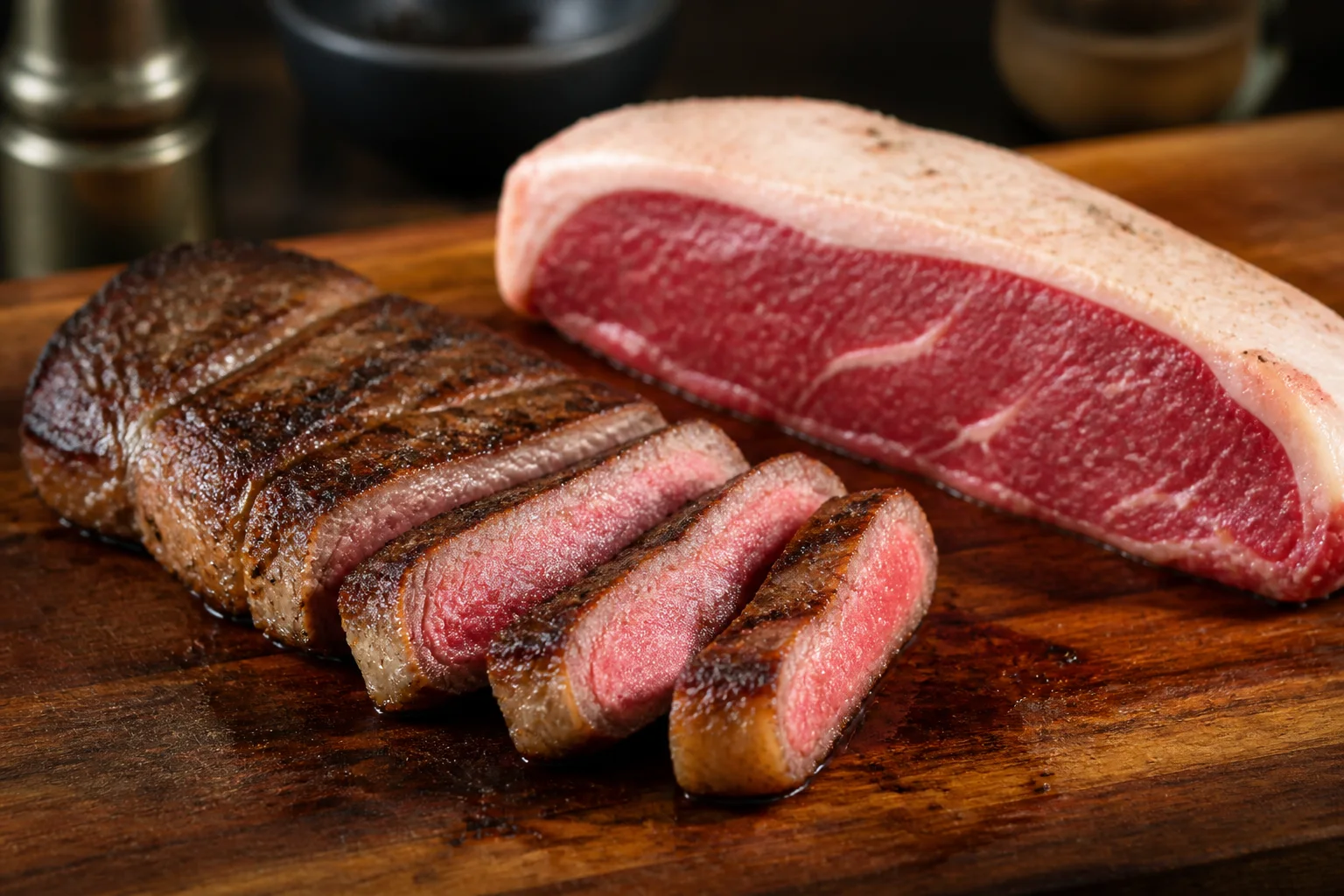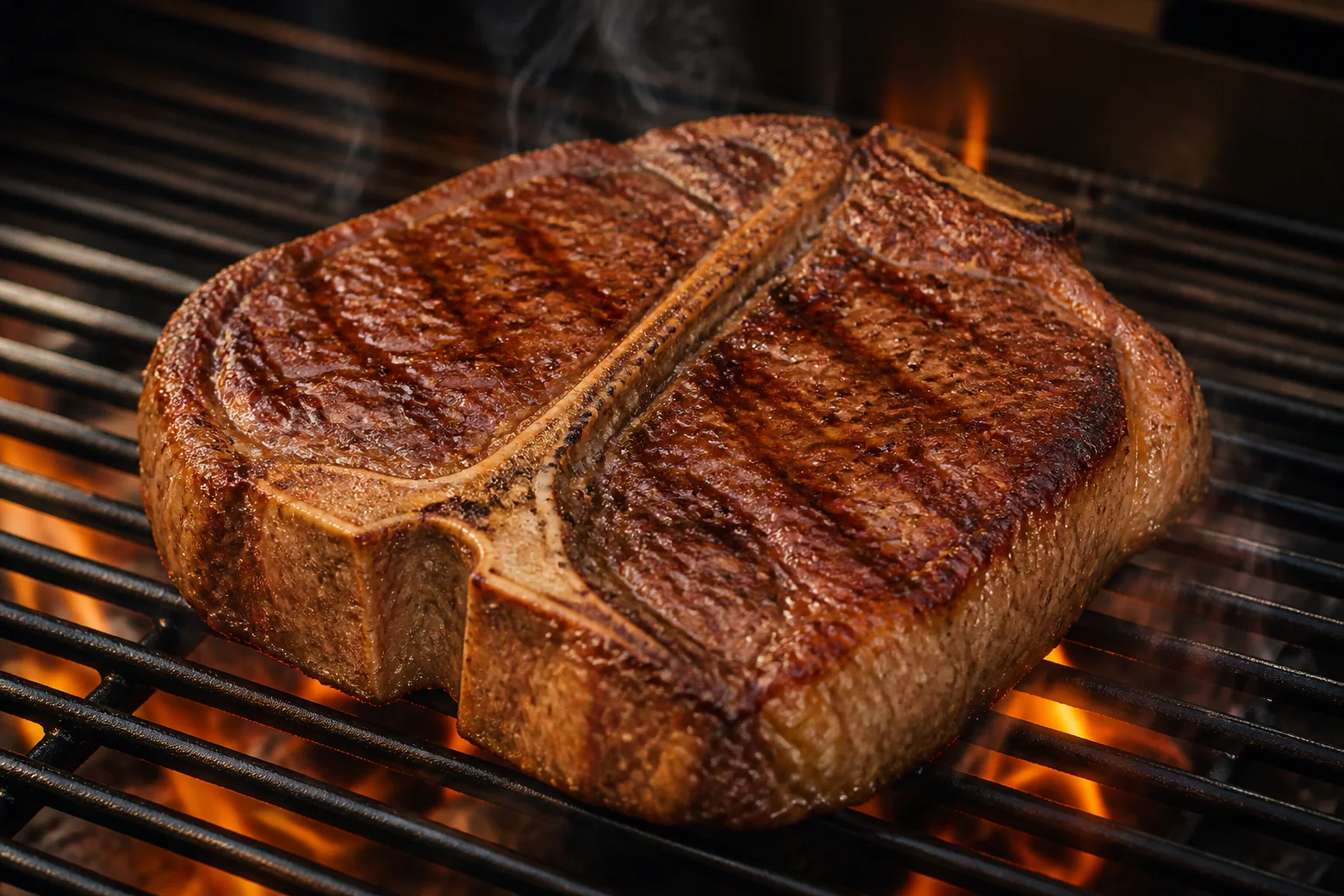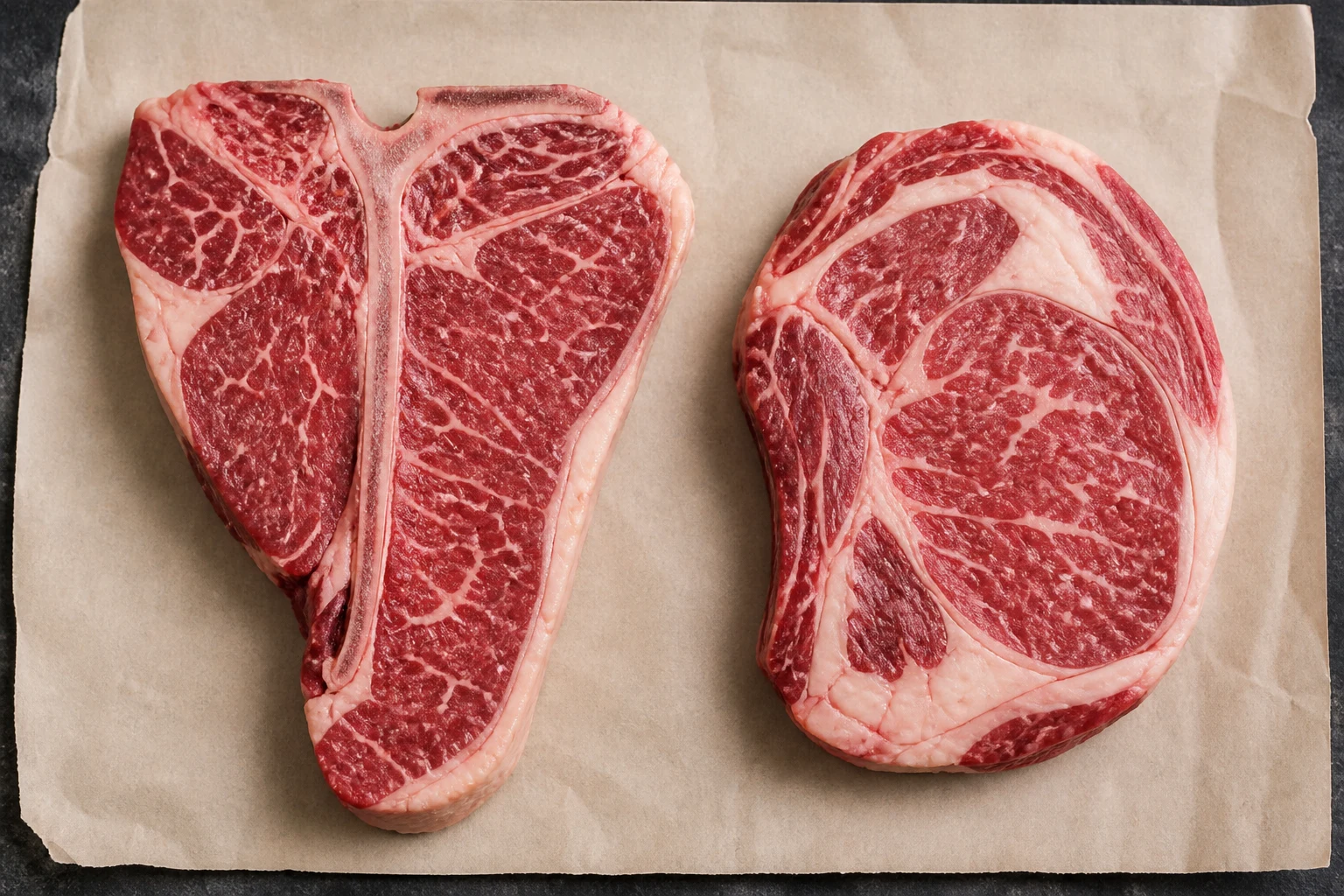
Porterhouse vs Ribeye: The Short Answer
Choose porterhouse for strip-and-filet contrast and ribeye for consistently rich rib-primal flavor; neither name establishes grade, aging or cooking quality. Porterhouse combines strip loin and tenderloin across a T-shaped bone; ribeye combines the eye, cap and other rib muscles. That structure changes every useful buying and cooking decision.
| Decision | Porterhouse | Ribeye |
|---|---|---|
| Cut identity | a short-loin steak with strip and tenderloin separated by a T-shaped bone; USDA IMPS specifies at least 1.25 inches at the tenderloin's maximum width. | a rib-primal steak built around the longissimus eye with cap and other muscles depending position and trim. |
| Eating texture | Two distinct textures: fine tenderloin and firmer, beefier strip. | Rich, marbled and multi-muscle, usually with more internal and seam fat than tenderloin. |
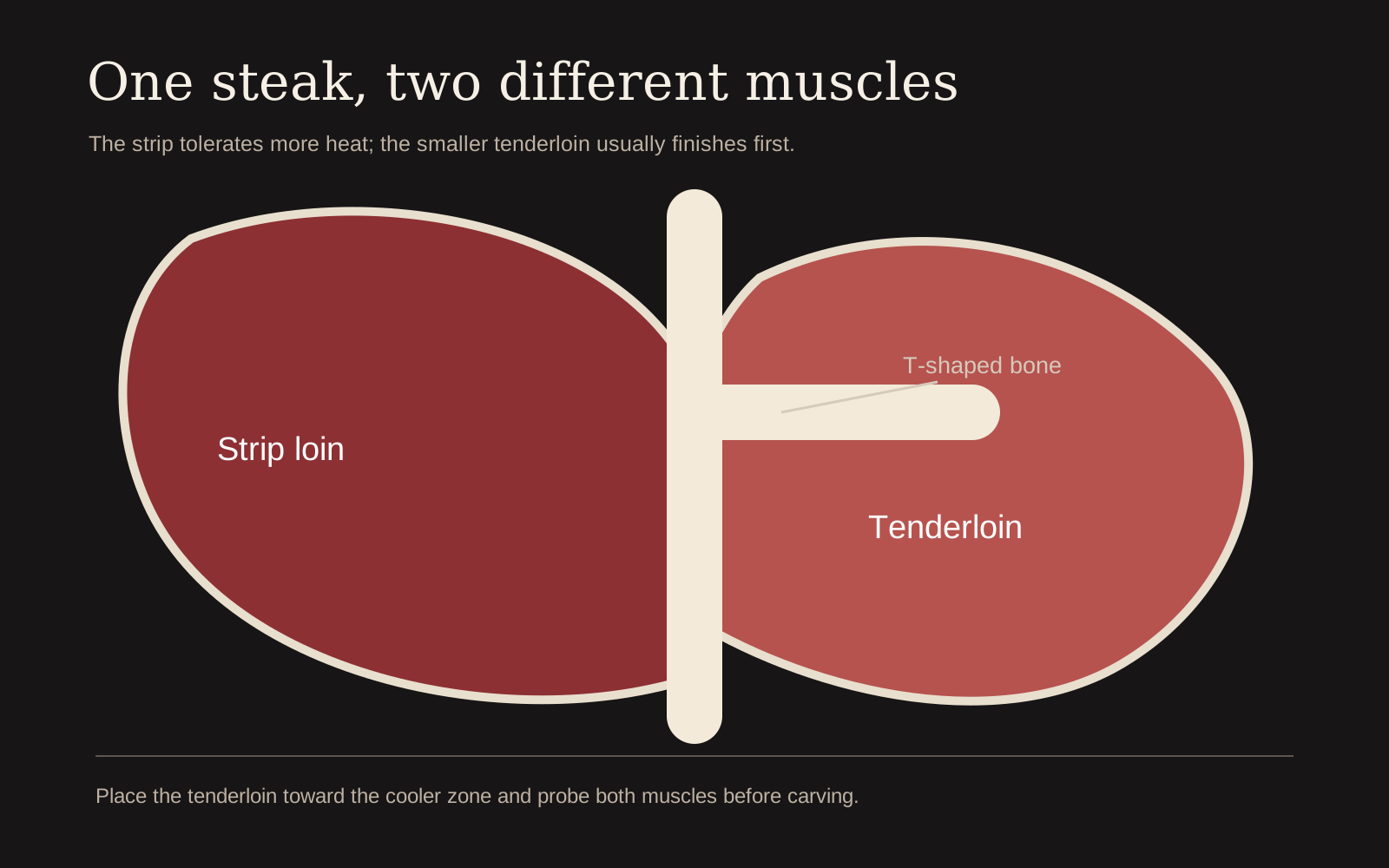
| Cooking challenge | The tenderloin can finish before the larger strip, so orienting and probing both muscles matters. | Fat seams can flare over fire, but there is no small lean tenderloin side to protect. |
| Value question | A large sharing steak with two premium muscles, central bone and variable tenderloin yield. | More of the purchase is the ribeye muscle family, with boneless and bone-in formats available. |
Open the full Porterhouse guide and Ribeye guide when you need the individual anatomy and method details. This page owns only the head-to-head decision so the three URLs do not repeat one another.
Anatomy Before Marketing
Porterhouse is a short-loin steak with strip and tenderloin separated by a T-shaped bone; USDA IMPS specifies at least 1.25 inches at the tenderloin's maximum width. Ribeye is a rib-primal steak built around the longissimus eye with cap and other muscles depending position and trim. Those are structural facts. Grade, breed, aging and seller program are separate variables that can change quality within either cut.
A comparison photograph is useful only when the steaks are shown at a similar scale and their defining structures are visible. Bone length, muscle borders, fat seams and tenderloin width can be inspected; tenderness, grade and origin cannot be proven from an image alone.
Names also shift between menus and retail counters. Ask for the standardized cut or muscle when a seller-specific label does not match the structure in front of you. That question prevents a premium adjective from becoming the only evidence.
How to Buy the Better Steak for Your Dinner
Measure the porterhouse tenderloin at its widest point and inspect both sides; on ribeye, compare eye size, cap, seam fat and rib position. Hold grade and aging constant. Compare equal grade, aging, thickness and delivery cost before calculating value. A price-per-pound comparison is incomplete when one option contains substantially more bone, exterior fat or trim.
- Verify identity. Match the label to the muscle and bone format rather than trusting a menu nickname.
- Hold quality variables constant. Compare like grade, program, aging and thickness before crediting the cut for every difference.
- Estimate edible yield. Bone and hard seam fat affect the cost of the food that reaches the plate.
- Check geometry. Even thickness is easier to cook than a dramatic but heavily tapered piece.
- Plan the fire before paying. The larger or more complex steak may require two zones, an oven stage or a pan your kitchen does not have.
Cooking Strategy and Temperature Control
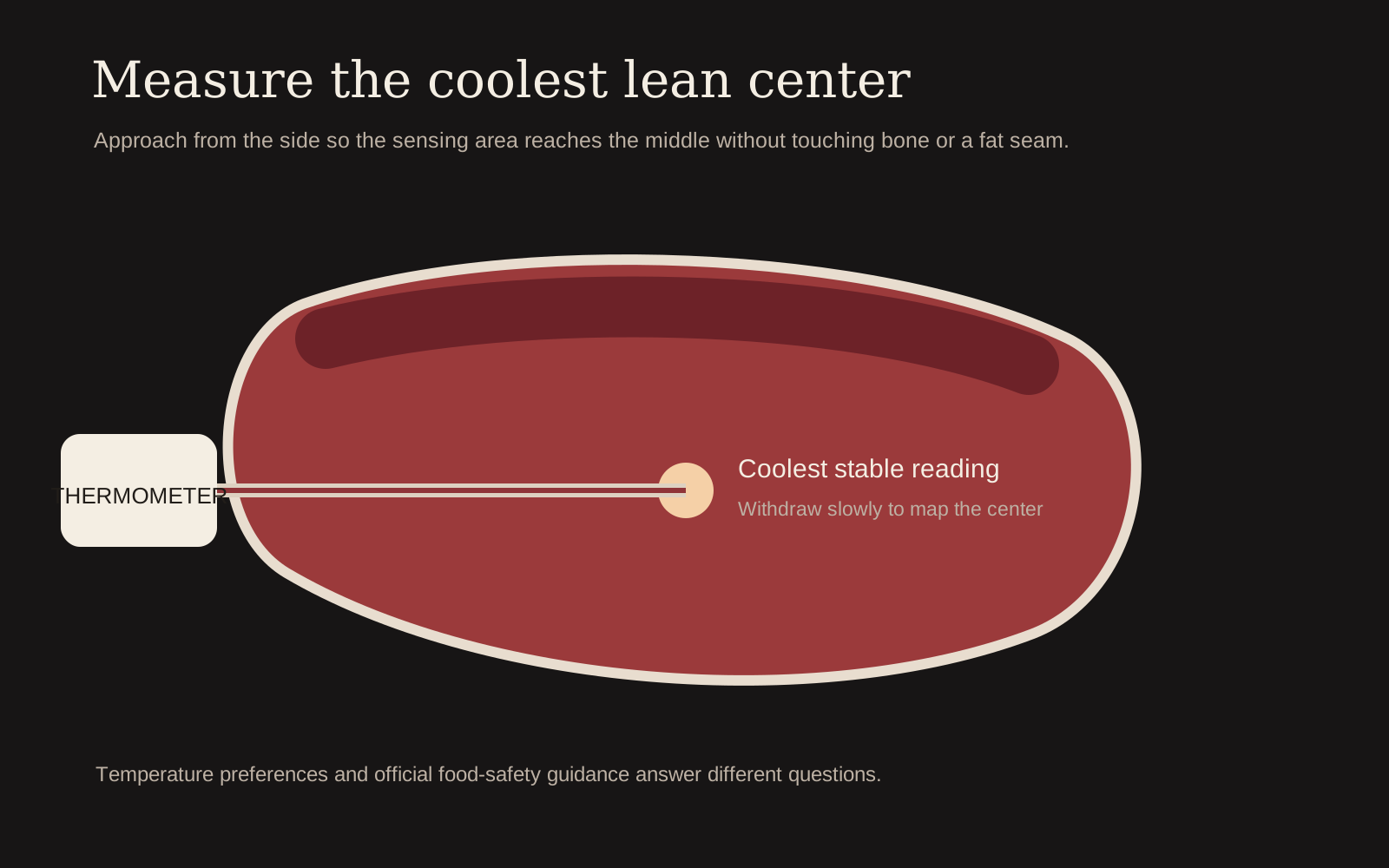
A thick porterhouse benefits from two heat zones and separate readings in strip and tenderloin. Ribeye needs flare control and probing away from the cap seam. Thickness determines whether direct heat is enough or a two-stage method is warranted. Build a cooler zone before cooking instead of waiting for the exterior to burn.
For Porterhouse, The tenderloin can finish before the larger strip, so orienting and probing both muscles matters. For Ribeye, Fat seams can flare over fire, but there is no small lean tenderloin side to protect. Insert the thermometer from the side into the coolest lean center and keep the sensing area away from bone, a fat pocket and the hot cooking surface.
Claims That Need More Precision
| Claim | More accurate reading |
|---|---|
| Porterhouse requires a 1.5-inch filet | USDA IMPS 1173 specifies at least 1.25 inches at the maximum tenderloin width |
| Bone-in ribeye is automatically juicier | Grade, thickness and endpoint are stronger controls than the presence of bone |
| Porterhouse has one doneness zone | Its strip and tenderloin are different muscles and should both be checked |
| Ribeye is always more tender | Ribeye is rich and tender, while porterhouse tenderloin is a separate exceptionally tender muscle |
A useful steak guide separates observation from explanation. A steak can be juicy because it was well marbled and not overcooked; that does not prove the nearby bone injected flavor or sealed moisture into the lean. A premium result may reflect grade, aging and fabrication rather than the name alone.
The same discipline applies to cooking times. Minutes per side are planning prompts, not endpoints. Grill output, pan recovery, wind, starting temperature, thickness and bone geometry change elapsed time even when two packages show the same weight.
Carving, Serving and the Final Choice
For porterhouse, remove strip and tenderloin from the bone and slice each across its own grain. For ribeye, separate very large cap or seam sections only when that improves cross-grain carving. Rest on a rack or warm board, then identify each muscle before carving. Slice across local grain, redistribute the richer and leaner pieces across portions, and reserve bones or trim for another use only when they were handled safely.
| Choose this priority | Better starting choice | Reason |
|---|---|---|
| Simplest heat control | Porterhouse | Fewer competing zones or easier geometry |
| Most dramatic presentation | Ribeye | Presentation is a valid goal when its cost is explicit |
| Strongest value comparison | Either, after edible-yield math | Grade, trim, bone and landed price can outweigh the cut name |
| Learning opportunity | Cook both to the same measured endpoint | A controlled comparison reveals texture rather than mythology |
Continue with porterhouse steak, ribeye steak, t bone steak, filet mignon, new york strip steak, steak temperature for the individual cut, method and temperature decisions behind this comparison.
Where This Guide Fits
This page supports the broader New York Strip Steak guide. Use that pillar page for the complete cut family, buying framework and links to every closely related article.
Useful next reads include Kansas City Strip Steak, Shell Steak, T-Bone Steak, Ribeye Steak, and Filet Mignon for nearby cuts, methods and decisions.
Frequently Asked Questions
Which is better, Porterhouse or Ribeye?
Choose porterhouse for strip-and-filet contrast and ribeye for consistently rich rib-primal flavor; neither name establishes grade, aging or cooking quality.
Which one is easier to cook?
A thick porterhouse benefits from two heat zones and separate readings in strip and tenderloin. Ribeye needs flare control and probing away from the cap seam.
Does the bone make steak more flavorful or juicy?
Bone changes geometry and presentation, but a steak's marbling, surface browning, thickness and measured doneness are more direct explanations for flavor and juiciness.
How should I compare prices?
Hold grade, aging and thickness constant, then include bone, hard trim, edible cooked yield and delivery cost.
Sources & further reading
- USDA FSIS — Safe Minimum Internal Temperature Chart — Official 145°F plus three-minute rest guidance for whole beef steaks and roasts, and 160°F guidance for ground beef.
- USDA FSIS — Food Thermometers — Official probe-placement guidance for steaks, roasts and thin patties.
- USDA AMS — Institutional Meat Purchase Specifications, Fresh Beef Series 100 — Federal purchasing specifications for brisket, chuck, ribeye and porterhouse anatomy.